Bear, Panda, Weasel, Red Panda, Racoon Family Tree
| Ruddy panda | |
|---|---|
 | |
| Conservation status | |
| | |
| CITES Appendix I (CITES)[1] | |
Scientific classification  | |
| Kingdom: | Animalia |
| Phylum: | Chordata |
| Class: | Mammalia |
| Gild: | Carnivora |
| Family: | Ailuridae |
| Genus: | Ailurus F. Cuvier, 1825 |
| Species: | A. fulgens |
| Binomial proper noun | |
| Ailurus fulgens F. Cuvier, 1825 | |
| Subspecies | |
| A. f. fulgens F. Cuvier, 1825 | |
 | |
| Range of the red panda | |
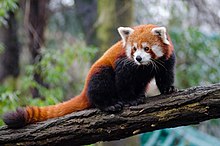
The red panda (Ailurus fulgens), likewise known every bit the lesser panda, is a small mammal native to the eastern Himalayas and southwestern People's republic of china. It has dense red-brown fur, white-lined ears, a mostly white cage and a ringed tail. Its head-to-body length is 51–63.five cm (20.1–25.0 in) with a 28–48.5 cm (11.0–19.one in) tail, and it weighs between three.two and 15 kg (seven.1 and 33.1 lb). It is well adapted to climbing due to its flexible joints and curved semi-retractile claws.
The red panda was first described in 1825. The two currently recognised subspecies, the Himalayan and the Chinese red panda, genetically diverged about 250,000 years ago. The red panda's place on the evolutionary tree has been debated, but modern genetic testify places it in shut affinity with raccoons and weasels. It is not closely related with the giant panda (Ailuropoda melanoleuca), which is a bear, though both possess elongated wrist bones or "false thumbs" used for grasping bamboo. The evolutionary lineage of the red panda stretches back around 25 to xviii million years ago, every bit indicated by extinct fossil relatives found in Eurasia and Northward America.
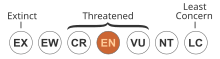
The red panda inhabits coniferous forests also as temperate broadleaf and mixed forests, favouring steep slopes with dense bamboo cover close to water sources. It is lonely and largely arboreal. It feeds mainly on bamboo shoots and leaves, only likewise on fruits and blossoms. Ruby pandas mate in early spring, with the females giving birth to litters of upward to 4 cubs in summer. It is threatened by poaching too as destruction and fragmentation of habitat due to deforestation. The species has been listed every bit Endangered on the IUCN Cherry List since 2015. It is protected in all range countries.
Community-based conservation programmes have been initiated in Nepal, Bhutan and northeastern India; in China, it benefits from nature conservation projects. The International Red Panda Day is celebrated annually in September. Regional captive convenance programmes for the red panda have been established in zoos around the world. Information technology is featured in animated movies, video games, comic books and as the namesake of companies and music bands.
Etymology
The name "panda" is thought to have originated from the red panda's local Nepali proper name पञ्जा pajā "claw" or पौँजा paũjā "paw".[three] [iv] In English, it was simply chosen "panda"; when the giant panda (Ailuropoda melanoleuca) was formally described and named in 1869, it became known equally the "ruddy panda" or "lesser panda" to distinguish information technology from the larger animal.[4] The genus name Ailurus is adopted from the ancient Greek word αἴλουρος ( ailouros ), pregnant "true cat".[5] The specific epithet fulgens is Latin for "shining, bright".[6] [4]
Taxonomy

The reddish panda was classified and formally described in 1825 by Frederic Cuvier, who gave it its current scientific proper noun Ailurus fulgens. Cuvier's description was based on zoological specimens, including pare, paws, jawbones and teeth "from the mountains north of India", as well equally an account by Alfred Duvaucel.[vii] [8] The reddish panda was described earlier by Thomas Hardwicke in 1821, but his paper was published only 6 years later.[4]
In 1847, Brian Houghton Hodgson described a red panda from the Himalayas, for which he proposed the name Ailurus ochraceus.[9] For a long time, Hodgson'south account was the just information available about the carmine panda'southward behaviour in the wild.[4] In 1902, Oldfield Thomas described a skull of a male red panda specimen nerveless in Sichuan past Frederick William Styan under the name Ailurus fulgens styani.[2]
Subspecies and species
The modernistic cherry-red panda is the only recognised species of the genus Ailurus. Information technology is traditionally divided into two subspecies: the Himalayan red panda (A. f. fulgens) and the Chinese scarlet panda (A. f. styani). The Himalayan subspecies has a straighter profile, a lighter coloured forehead and ochre-tipped hairs on the lower dorsum and rump. The Chinese subspecies has a more curved forehead, steeper muzzle slope, a darker coat with a redder, less white confront and more contrast between the tail rings.[10]
In 2020, results of a genetic analysis of cherry-red panda samples showed that the carmine panda populations in the Himalayas and Mainland china were separated nearly 250,000 years ago. The researchers suggested that the ii subspecies should be treated equally singled-out species. Red pandas in southeastern Tibet and northern Myanmar were found to exist part of styani, while those of southern Tibet were of fulgens (sensu stricto).[11] DNA sequencing of 132 red panda faecal samples nerveless in Northeast Bharat and Communist china besides showed two distinct clusters indicating that the Siang River in Arunachal Pradesh constitutes the boundary between the Himalayan and Chinese crimson pandas.[12] They probably diverged due to glaciation events on the southern Tibetan Plateau in the Pleistocene.[13]
Phylogeny
The placement of the crimson panda on the evolutionary tree has been debated. In the first half of the 20th century, diverse scientists placed it in the family Procyonidae with raccoons and their allies. At the time, nigh prominent biologists besides considered the red panda to exist related to the giant panda and classified both in the subfamily Ailurinae within Procyonidae. The giant panda would eventually be establish to exist a comport. A 1982 study examined the similarities and differences in the skull betwixt the red panda and the giant panda, other bears and procyonids, and placed the species in its own family Ailuridae. The author of the study considered the red panda to be more closely related to bears.[x]
A 1995 mitochondrial DNA analysis revealed that the carmine panda has close affinities with procyonids.[xiv] Further genetic studies have placed the ruby panda within the clade Musteloidea, which also includes Procyonidae, Mustelidae (weasels and relatives) and Mephitidae (skunks and relatives). The following cladogram is based on the molecular phylogeny of six genes,[15] with the musteloids updated following a multigene analysis.[16]
Fossil record
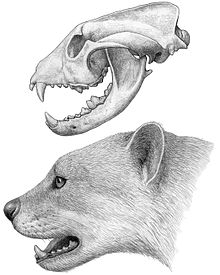
Reconstructed skull and caput of Simocyon
The family Ailuridae appears to have originated in Europe sometime during the Late Oligocene or Early Miocene, nigh 25 to 18 million years ago. The earliest member Amphictis is known from its 10 cm (4 in) skull and may have been around the same size every bit the modern species. Its dentition consists of pointed premolars, relatively precipitous-edged carnassials (P4 and m1) and molars with grinding surfaces (M1, M2 and m2), suggesting that it had a generalized carnivorous nutrition. Its placement within Ailuridae is based on the lateral grooves on its canine teeth. Other early or basal aliruds include Alopecocyon and Simocyon, whose fossils have been found throughout Eurasia and N America dating from the Middle Miocene, the latter of which survived into the Early Pliocene. Both take similar teeth to Amphictis and thus had a similar diet.[17] The puma-sized Simocyon was likely a tree-climber and shares a "false thumb"—an extended wrist bone—with the modern species, suggesting the appendage was an adaptation to arboreal locomotion and not to feed on bamboo.[17] [18]
Afterward and more advanced ailruds are classified in the subfamily Ailurinae and are known as the "true" carmine pandas. These animals were smaller and more adjusted for an omnivorous or herbivorous nutrition. The earliest known true panda is the species Magerictis imperialensis from the Heart Miocene of Spain and known only from a single tooth, a lower second molar. The molar shows both bequeathed and new characteristics having a relatively low and uncomplex crown simply also an elongated crushing surface and well-differentiated molar cusps similar later on species.[nineteen] Afterward ailurines include Pristinailurus bristoli of Tardily Miocene-Early Pliocene eastern North America[xix] [20] and species of the genus Parailurus which commencement appear in Early on Pliocene Europe, spreading beyond Eurasia into North America.[xix] [21] These animals are probable to be function of a sister taxon to the lineage of the modern panda. In contrast to the herbivorous modern species, these ancient pandas were likely omnivores, possessing many cusps on the molars but retaining sharp premolars.[19] [22] [twenty]
The primeval fossil tape of the modernistic genus Ailurus engagement no earlier than the Pleistocene and appears to take been express to Asia. The modern panda's lineage became adapted for a specialized bamboo diet, having molar-like premolars and more highly crowned cusps.[19] The false thumb would secondarily gain a function in feeding.[17] [xviii]
Genomics
Analysis of 53 red panda samples from Sichuan and Yunnan showed a high level of genetic diverseness.[23] The total genome of the red panda was sequenced in 2017. Researchers have compared it to the genome of the behemothic panda to learn the genetics of convergent evolution, as both species have imitation thumbs and are adapted for a specialized bamboo diet despite having the digestive system of a carnivore. Both pandas show modifications to certain limb evolution genes (DYNC2H1 and PCNT), which may play roles in the development of the thumbs.[24] In switching from a carnivorous to a herbivorous diet, both species have reactivated taste receptor genes used for detecting bitterness, though the specific genes are different.[25]
Characteristics

Cerise panda skull

Ruby-red panda face
The red panda's coat is mainly red or orange-brown with a black belly and legs. The face is mostly white and has ruby-red marks that stretch from the side angle of the eyes to the corners of the mouth. The inside of the ears are covered in white fur with a red patch in the centre.[26] Its bushy tail has alternating rings of red and buff.[27] [26] The colouration appears to serve equally camouflage in a habitat with ruddy moss- and white lichen-covered copse. The fur consists of fibroid guard hairs with a soft dumbo, woolly undercoat.[27] The guard hairs on the back have a circular cross-department and are 47–56 mm (1.9–2.2 in) long. Information technology has moderately long whiskers around the mouth, lower jaw and chin.[26]
The red panda has a caput-body length of 51–63.5 cm (xx.1–25.0 in) with a 28–48.v cm (xi.0–19.1 in) tail. The Himalayan scarlet panda is recorded to weigh 3.2–9.4 kg (vii.1–20.7 lb), while the Chinese reddish panda weighs 4–15 kg (viii.viii–33.1 lb) for females and 4.2–thirteen.4 kg (ix.three–29.5 lb) for males.[26] The panda has a relatively small head with a reduced snout and triangular ears, though proportionally larger than in similarly sized raccoons, while the limbs are nearly equal in length.[26] [27] The crimson panda has 5 curved digits on each foot, which end in curved semi-retractile claws that assist in climbing.[27] The pelvis and hindlimbs have flexible joints, adaptations for an arboreal quadrupedal lifestyle.[28] While not prehensile, the tail acts as back up and counterbalance when climbing.[27]
The forepaws possess a "false thumb", which is an extension of a wrist bone, the radial sesamoid establish in many carnivorans. This thumb allows the animal to agree onto bamboo stalks and carve up leaves, and both the digits and wrist bones requite the carmine panda remarkable dexterity. The scarlet panda shares this feature with the giant panda, which has a larger sesamoid that is more compressed at the sides. In addition, the red panda's sesamoid has a more concave tip while the giant panda'south hooks in the middle.[29]
Its skull is wide, and its lower jaw is robust.[27] [26] Nevertheless, because it eats the less fibrous parts of bamboo, the leaves and stems, it has less-developed chewing muscles than the giant panda. The digestive tract of the red panda is also typical of a carnivore, being fairly curt, at only 4.2 times its trunk length, with a simple tummy, no clear distinction between the ileum and the colon, and no caecum.[26] Microbes in its gut may play a function in its processing of bamboo; the microbiota community in the red panda is less diverse than in other mammals.[xxx]
Distribution and habitat

The red panda is distributed from western Nepal, the states of Sikkim, West Bengal and Arunachal Pradesh in India, Bhutan and southern Tibet to northern Myanmar and Cathay's Sichuan and Yunnan provinces.[1] The global potential habitat of the carmine panda has been estimated to comprise 47,100 km2 (xviii,200 sq mi) at most; this habitat is located in the temperate climate zone of the Himalayas with a mean almanac temperature range of 18–24 °C (64–75 °F).[31] Throughout this range, it has been recorded at elevations of 2,000–iv,300 thou (6,600–xiv,100 ft).[32] [33] [34] [35] [36]
| Land | Estimated size[31] |
|---|---|
| Nepal | 22,400 km2 (eight,600 sq mi) |
| People's republic of china | 13,100 kmii (v,100 sq mi) |
| India | 5,700 kmtwo (two,200 sq mi) |
| Myanmar | 5,000 km2 (1,900 sq mi) |
| Kingdom of bhutan | 900 km2 (350 sq mi) |
| Total | 47,100 km2 (xviii,200 sq mi) |
In Nepal, information technology lives in 6 protected expanse complexes within the Eastern Himalayan broadleaf forests ecoregion.[34] The westernmost records to engagement were obtained in three community forests in Kalikot District in 2019.[37] Panchthar and Ilam Districts correspond its easternmost range in the land, where its habitat in forest patches is surrounded by villages, livestock pastures and roads.[38] The metapopulation in protected areas and wildlife corridors in the Kangchenjunga landscape of Sikkim and northern West Bengal is partly connected through quondam-growth forests exterior protected areas.[39] Forests in this landscape are dominated by Himalayan oaks (Quercus lamellosa and Q. semecarpifolia), Himalayan birch (Betula utilis), Himalayan fir (Abies densa), Himalayan maple (Acer caesium) with bamboo, Rhododendron and some black juniper (Juniperus indica) shrub growing in the understoreys.[32] [40] [41] [42] Records in Kingdom of bhutan, Arunachal Pradesh's Pangchen Valley, West Kameng and Shi Yomi districts signal that it frequents habitats with Yushania and Thamnocalamus bamboo, medium-sized Rhododendron, Sorbus and Castanopsis trees.[33] [43] [44] In China, information technology inhabits the Hengduan Mountains subalpine conifer forests and Qionglai-Minshan conifer forests in the Hengduan, Qionglai, Xiaoxiang, Daxiangling and Liangshan Mountains in Sichuan.[45] In the side by side Yunnan province, it was recorded only in the northwestern montane part.[46] [47]
The red panda prefers microhabitats inside seventy–240 k (230–790 ft) of water sources.[48] [49] [50] [51] Fallen logs and tree stumps are important habitat features, every bit they facilitate access to bamboo leaves.[52] Red pandas have been recorded to use steep slopes of more than 20° and stumps exceeding a bore of 30 cm (12 in).[48] [53] Red pandas observed in Phrumsengla National Park used foremost easterly and southerly slopes with a mean slope of 34° and a canopy encompass of 66 percent that were overgrown with bamboo about 23 m (75 ft) in summit.[49] In Dafengding Nature Reserve, it prefers steep south-facing slopes in winter and inhabits forests with bamboo 1.five–2.5 thou (4 ft 11 in – eight ft two in) tall.[54] In Gaoligongshan National Nature Reserve, it inhabits mixed coniferous forest with a dense canopy cover of more than than 75 pct, steep slopes and a density of at least lxx bamboo plants/mii (half-dozen.5 bamboo plants/sq ft).[55] In China's Fengtongzhai and Yele Natural Reserves, the red panda selects steep slopes and a high density of bamboo stems, fallen logs and stumps, whereas the giant panda prefers gentle slopes with taller bamboo just lower densities of stems, logs and stumps. Such niche separation lessens contest between the 2 bamboo-eating species.[48] [52]
Behaviour and ecology
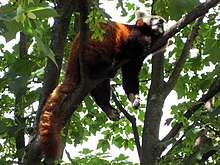
Red panda sleeping on a tree
The cherry panda is difficult to discover in the wild,[56] and well-nigh studies on its behaviour have taken place in captivity.[57] The cherry-red panda appears to exist both nocturnal and crepuscular, sleeping in betwixt periods of activeness at night. It typically rests or sleeps in trees or other elevated spaces, stretched out on a branch with legs dangling when it is hot, and curled upwards with its tail over the face when information technology is common cold. It is adapted for climbing and descends to the ground head-start with the hindfeet holding on to the middle of the tree trunk. Information technology moves apace on the ground by trotting or bounding. Its lifespan in captivity reaches 14 years.[27]
Adult pandas are mostly alone and territorial. Individuals mark their domicile range or territorial boundaries with urine, faeces and secretions from the anal and surrounding glands. Odour-marking occurs more on the footing, and males marker more oftentimes and for longer periods than females.[27] In Cathay's Wolong National Nature Reserve, the dwelling house range of a radio-collared female person was 0.94 kmtwo (0.36 sq mi), while that of a male was 1.xi km2 (0.43 sq mi).[58] A one-year-long monitoring study of ten red pandas in eastern Nepal showed that the four males had median home ranges of 1.73 km2 (0.67 sq mi) and the six females of 0.94 km2 (0.36 sq mi) within a wood encompass of at least 19.2 ha (47 acres). The females travelled 419–841 m (1,375–2,759 ft) per day and the males 660–1,473 chiliad (2,165–iv,833 ft). In the mating season from January to March, adults travelled a mean of 795 m (two,608 ft) and subadults a mean of 861 m (2,825 ft).[38] They all had larger dwelling house ranges in areas with low woods embrace and reduced their activity in areas that were disturbed past people, livestock and dogs.[59]
Diet and feeding

The scarlet panda is largely herbivorous and feeds primarily on bamboo, mainly the genera Phyllostachys, Sinarundinaria, Thamnocalamus and Chimonobambusa.[threescore] It also feeds on fruits, blossoms, acorns, eggs, birds and pocket-size mammals. Information technology mainly eats the leaves of bamboo, which are frequently the only available food item in the wintertime and the most mutual nutrient for the residual of the year.[61] In Wolong National Nature Reserve, leaves of Bashania fangiana were found in near 94 percent of analysed debris, and its shoots were institute in 59 percent of the droppings establish in June.[58]
The diet of scarlet pandas monitored at three sites in Singalila National Park for ii years consisted of xl–83 percent Yushania maling and 51–91.two pct Thamnocalamus spathiflorus bamboos[a] supplemented by bamboo shoots, Actinidia strigosa fruits and seasonal berries.[64] In this national park, ruddy panda droppings besides contained remains of silky rose and bramble fruit species in the summer flavor, Actinidia callosa in the mail-monsoon season, and Merrilliopanax alpinus, whitebeam (Sorbus cuspidata) and tree rhododendron in both seasons. Droppings were found on 23 found species including the stone oak (Lithocarpus pachyphyllus), Campbell's magnolia (Magnolia campbellii), chinquapin (Castanopsis tribuloides), Himalayan birch, Litsea sericea and the holly species Ilex fragilis.[65] In Nepal's Rara National Park, Thamnocalamus was found in 100 percent of debris sampled, both earlier and after the monsoon.[66] Its summer diet in Dhorpatan Hunting Reserve also includes some lichens and barberries.[40] In Bhutan'due south Jigme Dorji National Park, crimson panda faeces plant in the fruiting flavour independent seeds of Himalayan ivy (Hedera nepalensis).[51]
The red panda grabs food with one of its forepart paws and usually eats sitting down or standing, just sometimes lays on its dorsum. When foraging for bamboo, it grabs the plant by the stem and bends it down so the leaves are within reach of the jaws. Information technology inserts them into the side and shears and chews them. It nips small nutrient like blossoms, berries and small leaves with the incisors.[27] Having the digestive organization of a carnivore, the red panda is a poor processor of bamboo, which passes through its gut in two to four hours. Information technology hence selects the more than nutritious found matter, such equally tender leaves and shoots, and consumes them in large quantities. It eats over 1.v kg (three lb 5 oz) of fresh leaves or 4 kg (9 lb) of fresh shoots in a solar day and can digest crude proteins and fats more than easily than fibres and lignin in the bamboo leaves. Bamboo is almost digestible in summer and fall only least in winter, and shoots are more than digestible than leaves.[67]
Communication
Sounds of cerise panda twittering
At to the lowest degree seven unlike vocalisations have been recorded in the red panda, comprising growls, barks, squeals, hoots, bleats, grunts and twitters. Growling, barking, grunting and squealing are produced during fights and aggressive chasing. Hooting is fabricated in response to existence approached by some other individual. Bleating is recorded afterward scent-marking and sniffing. Males may squeal during courtship, peculiarly before mounting. Twittering is made past mating females.[68] During both play fighting and aggressive fighting, individuals arch their backs and tails while slowly moving their heads up and down. They and so plow their heads while jaw-clapping, move their heads side to side and heighten a forepaw with an intent to strike. They stand on their hind legs and raise the forelimbs above the head before lunging. Two individuals "stare" each other from a distance.[27]
Reproduction and parenting
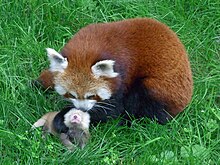
Cherry panda tending its cub
Red pandas are "long-day" breeders, meaning that breeding occurs as the length of daylight increases following the winter solstice. Mating thus occurs mostly between January and March, with births taking place from May to Baronial. For captive pandas in the southern hemisphere, reproduction is delayed by six months. Oestrous lasts a day, and females tin enter oestrous multiple times a season, but the length of intervals betwixt each bicycle is not clear.[69]
Every bit the convenance flavor begins, at that place are increased interactions between males and females, who will remainder, move and feed close to each other. Oestrous females are observed to mark more oftentimes and more vigorously and males will sniff their anogenital region. Receptive females make tail-flicks and position themselves in a lordosis pose, with the front lowered and the back arched. Copulation involves the male mounting the female from backside and on top, though contiguous matings every bit well every bit belly-to-back matings while lying on the sides have been observed. The male person usually does not seize with teeth the female'due south neck but will grab her sides with his front paws. Mountings are ii–25 minutes long, and the couple grooms each other betwixt mounting bouts.[69]
Gestation lasts nigh 158 days. Prior to giving birth, the female person selects a denning site, such as a tree, log or stump hollow or rock crevice, and builds a nest using textile from nearby, such equally twigs, sticks, branches, bawl bits, leaves, grass and moss.[56] Litters typically consist of one to four cubs that are born fully furred but blind. They are entirely dependent on their female parent for the showtime three to four months until they emerge from the nest. They nurse for their first five months.[70] Mother and offspring stay together until the next breeding. Cubs reach their adult size at effectually 12 months and sexual maturity at around 18 months.[27] Two radio-collared cubs in eastern Nepal separated from their mothers at the age of vii–8 months and left their birth areas three weeks later on. They reached new home ranges within 26–42 days and became residents subsequently exploring them for 42–44 days.[38]
Diseases
Faecal samples of crimson panda nerveless in Nepal contained parasitic protozoa, amoebozoans, roundworms, trematodes and tapeworms.[71] [72] Roundworms, tapeworms and coccidia were also institute in red panda scat collected in Rara and Langtang National Parks.[73] Fourteen scarlet pandas at the Knoxville Zoo suffered from severe ringworm, so the tails of two were amputated.[74] Chagas disease was reported as the cause of death of a red panda kept in a Kansas zoo.[75] Amdoparvovirus was detected in the scat of vi blood-red pandas in the Sacramento Zoo.[76] Eight convict red pandas in a Chinese zoo suffered from shortness of breath and fever shortly earlier they died of pneumonia; autopsy revealed that they had antibodies to the protozoans Toxoplasma gondii and Sarcocystis species indicating that they were intermediate hosts.[77] A convict ruddy panda in the Chengdu Inquiry Base of Giant Panda Breeding died of unknown reasons; an autopsy showed that its kidneys, liver and lungs were damaged by a bacterial infection caused by Escherichia coli.[78]
Threats
The primary threats to the red panda are destruction and fragmentation of habitat acquired by multiple circumstances such equally increasing human being population, deforestation, illegal collection of non-timber forest products and poaching, disturbances by herders and livestock and lack of law enforcement.[i] Small groups of animals with little opportunity for commutation between them face the risk of inbreeding, decreased genetic diversity, and fifty-fifty extinction. In improver, clearcutting for firewood or agriculture and hillside terracing removes one-time copse that provide maternal dens and decreases the power of some bamboo species to regenerate.[79] The cut lumber stock in Sichuan lonely reached 2,661,000 mthree (94,000,000 cu ft) in 1958–1960, and 3,597.9 km2 (1,389.two sq mi) of red panda habitat were logged between the mid 1970s and late 1990s.[46]
Deforestation inhibits the dispersal of red pandas and leads to severe fragmentation of the population; trampling past livestock depresses bamboo growth.[80] Throughout Nepal, the red panda habitat outside protected areas is negatively affected past solid waste material, livestock trails and herding stations, and people collecting firewood and medicinal plants.[40] [81] Threats identified in Nepal's Lamjung District include grazing past livestock during seasonal transhumance, human being-made forest fires and the collection of bamboo every bit cattle fodder in winter.[82] Vehicular traffic is a significant barrier to cherry-red panda movement between habitat patches.[59]
In Nepal's Taplejung Commune, cherry-red panda claws are used for treating epilepsy; its pare is used in rituals for treating sick people, making hats, scarecrows and decorating houses. Between 2008 and 2018, 121 skins were confiscated in the country.[83] In Myanmar, the red panda is threatened by hunting using guns and traps; since roads to the border with China were built starting in the early 2000s, ruby panda skins and live animals are traded and smuggled across the border.[36] In southwestern China, the red panda is hunted for its fur, especially for the highly valued bushy tails, from which hats are produced. The fur is used for local cultural ceremonies. At weddings, the bridegroom traditionally carries the hide. The "practiced-luck charm" red panda-tail hats are likewise used by local newlyweds. A 40 percent decrease in red panda populations has been reported in China over the final 50 years, and populations in western Himalayan areas are considered to be smaller.[46] Between 2005 and 2017, 35 live and seven dead cherry pandas were confiscated in Sichuan, and several traders were sentenced to iii–12 years of imprisonment. A month-long survey of 65 shops in 9 Chinese counties in the spring of 2017 revealed only one in Yunnan offered hats fabricated of ruby panda skins, and red panda tails were offered in an online forum.[84]
Conservation
The red panda is listed in CITES Appendix I and protected in all range countries; hunting is illegal. It has been listed equally Endangered on the IUCN Red List since 2008 because the global population is estimated at 10,000 individuals, with a decreasing population trend. A large extent of its habitat is part of protected areas.[one]
| Country | Protected areas |
|---|---|
| Nepal | Api Nampa Conservation Area, Khaptad National Park, Rara National Park, Annapurna Conservation Area, Manaslu Conservation Area, Langtang National Park, Gaurishankar Conservation Expanse, Sagarmatha National Park, Makalu Barun National Park, Kanchenjunga Conservation Area[34] |
| India | Khangchendzonga National Park, Singalila National Park, Varsey Rhododendron Sanctuary, Shingba Rhododendron Sanctuary, Fambong Lho Wild animals Sanctuary, Kyongnosla Tall Sanctuary, Pangolakha Wildlife Sanctuary, Maenam Wild animals Sanctuary,[39] Namdapha National Park[85] |
| Bhutan | Jigme Khesar Strict Nature Reserve, Jigme Dorji National Park, Wangchuck Centennial National Park, Jigme Singye Wangchuck National Park, Bumdeling Wild fauna Sanctuary, Sakteng Wild animals Sanctuary, Phrumsengla National Park, Jomotsangkha Wildlife Sanctuary[33] |
| Myanmar | Hkakaborazi National Park, Hponkanrazi Wildlife Sanctuary,[86] Imawbum National Park[36] |
| Mainland china | Yarlung Tsangpo G Canyon Nature Reserve[87] and vi more than nature reserves in Tibet, eight in Yunnan and 32 in Sichuan[88] |

Closeup await of blood-red panda
A reddish panda anti-poaching unit and community-based monitoring have been established in Langtang National Park. Members of Community Forest User Groups as well protect and monitor cerise panda habitats in other parts of Nepal.[89] Customs outreach programs have been initiated in eastern Nepal using information boards, radio broadcasting and the annual International Scarlet Panda Day in September; several schools endorsed a ruby panda conservation manual equally office of their curricula.[xc]
Since 2010, community-based conservation programmes accept been initiated in 10 districts in Nepal that aim to help villagers reduce their dependence on natural resources through improved herding and food processing practices and alternative income possibilities. The Nepali government ratified a 5-year Cerise Panda Conservation Action Plan in 2019.[91] From 2016 to 2019, 35 ha (86 acres) of loftier-elevation rangeland in Merak, Bhutan, was restored and fenced in cooperation with 120 herder families to protect the red panda forest habitat and improve communal pasture.[92] Villagers in Arunachal Pradesh established 2 community conservation areas to protect the carmine panda habitat from disturbance and exploitation of forest resource.[43] China has initiated several projects to protect its environment and wild animals, including Grain for Green, The Natural Forest Protection Project and the National Wild animals/Natural Reserve Construction Projection. For the last project, the scarlet panda is non listed as a fundamental fauna for protection but may benefit from the protection of the behemothic panda and golden snub-nosed monkey (Rhinopithecus roxellana), with which it overlaps in range.[88]
In captivity
The London Zoo acquired two red pandas in 1869 and 1876 that were caught in Darjeeling. The Calcutta Zoo received a live cerise panda in 1877, the Philadelphia Zoo in 1906, and Artis and Cologne Zoos in 1908. In 1908, the first crimson panda cubs were born in an Indian zoo. In 1940, the San Diego Zoo imported four red pandas via Bharat that had been caught in Nepal; their starting time litter was built-in in 1941. ubs that were born later were sent to other zoos; by 1969, about 250 red pandas had been exhibited in zoos.[93] The Taronga Conservation Society started keeping red pandas in 1977.[94]
In 1978, the International Cerise Panda Studbook was set up, followed by the Red Panda European Endangered Species Programme in 1985. Members of international zoos ratified a global chief plan for the captive breeding of the red panda in 1993. By belatedly 2015, 219 red pandas lived in 42 zoos in Japan.[95] The Padmaja Naidu Himalayan Zoological Park participates in the Red Panda Species Survival Plan and kept about 25 scarlet pandas by 2016.[96] By the stop of 2019, 182 European zoos kept 407 cherry-red pandas.[97] Regional captive breeding programmes accept also been established in North American, Australasian and South African zoos.[4]
Cultural significance
The cherry-red panda is depicted in a hunting scene of a Chinese Chou Dynasty scroll dating to the 13th century. In western Nepal, Magar shamans use their skin and fur in their ritual dresses and believe that it protects confronting evil spirits. Some tribal people in Arunachal Pradesh and the Yi people also believe that it brings good luck to vesture red panda tails or hats fabricated of its fur. People in key Bhutan consider red pandas to be reincarnations of Buddhist monks.[98]
A watercolour painting by an Indian artist dating to 1820 is among the earliest known paintings of the red panda.[99] The red panda was recognized as the state fauna of Sikkim in the early 1990s and was the mascot of the Darjeeling Tea Festival.[79] Anthropomorphic scarlet pandas feature in animated movies and TV series such every bit Bamboo Bears, Barbie as the Island Princess, the Kung Fu Panda franchise, Aggretsuko and Turning Scarlet, and in several video games and comic books. The red panda is the namesake of the Firefox browser, and it has been used every bit the namesake of other companies and of music bands.[98]
Notes
- ^ Labelled Arundinaria maling and A. aristata respectively, which are inferior synonyms of the species listed hither.[62] [63]
References
- ^ a b c d eastward Glatston, A.; Wei, F.; Than Zaw & Sherpa, A. (2017) [errata version of 2015 assessment]. "Ailurus fulgens". IUCN Red List of Threatened Species. 2015: e.T714A110023718. Retrieved 15 January 2022.
- ^ a b Thomas, O. (1902). "On the Panda of Sze-chuen". Annals and Magazine of Natural History. seven. 10 (57): 251–252. doi:10.1080/00222930208678667.
- ^ Turner, R. Fifty. (1931). "पञ्जा". A Comparative and Etymological Lexicon of the Nepali Language. London: K. Paul, Trench, Trübner. p. 359.
- ^ a b c d e f Glatston, A. R. (2021). "Introduction". In Glatston, A. R. (ed.). Red Panda: Biology and Conservation of the First Panda (2nd ed.). London: Academic Press. pp. xix–xxix. ISBN978-0-12-823753-3.
- ^ Liddell, H. Grand. & Scott, R. (1940). "αἴλουρος". A Greek-English language Dictionary (Revised and augmented ed.). Oxford: Clarendon Press.
- ^ Lewis, C. T. A. & Short, C. (1879). "fulgens". Latin Dictionary (Revised, enlarged, and in not bad part rewritten ed.). Oxford: Clarendon Press.
- ^ Cuvier, F. (1825). "Panda". In Geoffroy Saint-Hilaire, Eastward.; Cuvier, F. (eds.). Histoire naturelle des mammifères, avec des figures originales, coloriées, dessinées d'après des animaux vivans: publié sous l'autorité de l'administration du Muséum d'Histoire naturelle. Vol. Tome 5. Paris: A. Belin. p. LII one–3.
- ^ Cuvier, G. (1829). "Le Panda éclatant". Le règne animal distribué d'après son organization. Vol. Tome ane. Chez Déterville, Paris. p. 138.
- ^ Hodgson, B. H. (1847). "On the Cat-toed subplantigrades". Periodical of the Asiatic Society of Bengal. 16 (2): 1113–1128.
- ^ a b Groves, C. (2021). "The taxonomy and phylogeny of Ailurus". In Glatston, A. R. (ed.). Ruddy Panda: Biological science and Conservation of the Beginning Panda (Second ed.). London: Academic Press. pp. 95–117. ISBN978-0-12-823753-iii.
- ^ Hu, Y.; Thapa, A.; Fan, H.; Ma, T.; Wu, Q.; Ma, S.; Zhang, D.; Wang, B.; Li, M.; Yan, 50. & Wei, F. (2020). "Genomic evidence for two phylogenetic species and long-term population bottlenecks in ruby pandas". Science Advances. half-dozen (9): eaax5751. Bibcode:2020SciA....6.5751H. doi:10.1126/sciadv.aax5751. PMC7043915. PMID 32133395.
- ^ Joshi, B. D.; Dalui, S.; Singh, S. Grand.; Mukherjee, T.; Chandra, K.; Sharma, L. K. & Thakur, Grand. (2021). "Siang river in Arunachal Pradesh splits Ruby Panda into two phylogenetic species". Mammalian Biology. 101 (1): 121–124. doi:10.1007/s42991-020-00094-y. S2CID 231811193.
- ^ Dalui, S.; Singh, S. K.; Joshi, B. D.; Ghosh, A.; Basu, South.; Khatri, H.; Sharma, 50. K.; Chandra, K. & Thakur, M. (2021). "Geological and Pleistocene glaciations explain the demography and disjunct distribution of Red Panda (A. fulgens) in eastern Himalayas". Scientific Reports. 11 (1): 65. doi:10.1038/s41598-020-80586-half dozen. PMC7794540. PMID 33420314.
- ^ Pecon-Slattery, J. & O'Brien, Due south. J. (1995). "Molecular phylogeny of the red panda (Ailurus fulgens)". The Journal of Heredity. 86 (6): 413–422. doi:ten.1093/oxfordjournals.jhered.a111615. PMID 8568209.
- ^ Flynn, J. J.; Finarelli, J. A.; Zehr, S.; Hsu, J. & Nedbal, M. A. (2005). "Molecular phylogeny of the Carnivora (Mammalia): Assessing the impact of increased sampling on resolving enigmatic relationships". Systematic Biology. 54 (two): 317–337. doi:x.1080/10635150590923326. PMID 16012099.
- ^ Law, C. J.; Slater, Thousand. J. & Mehta, R. S. (2018). "Lineage Variety and Size Disparity in Musteloidea: Testing Patterns of Adaptive Radiation Using Molecular and Fossil-Based Methods". Systematic Biology. 67 (ane): 127–144. doi:x.1093/sysbio/syx047. PMID 28472434.
- ^ a b c Salesa, Thou. J.; Peigné, S.; Antón, M. & Morales, J. (2021). "The taxonomy and phylogeny of Ailurus". In Glatston, A. R. (ed.). Red Panda: Biology and Conservation of the First Panda (2nd ed.). London: Bookish Press. pp. 15–29. ISBN978-0-12-823753-iii.
- ^ a b Salesa, M. J.; Mauricio, A.; Peigné, South. & Morales, J. (2006). "Evidence of a false thumb in a fossil carnivore clarifies the evolution of pandas". PNAS. 103 (two): 379–382. Bibcode:2006PNAS..103..379S. doi:10.1073/pnas.0504899102. PMC1326154. PMID 16387860.
- ^ a b c d e Wallace, Southward. C. & Lyon, 50. (2021). "Systemic revision of the Ailurinae (Mammalia: Carnivora: Ailuridae): with a new species from N America". In Glatston, A. R. (ed.). Blood-red Panda: Biological science and Conservation of the Offset Panda (Second ed.). London: Academic Press. pp. 31–52. ISBN978-0-12-823753-3.
- ^ a b Wallace, S. C. & Wang, X. (2004). "Two new carnivores from an unusual late Third forest biota in eastern North America". Nature. 431 (7008): 556–559. Bibcode:2004Natur.431..556W. doi:10.1038/nature02819. PMID 15457257. S2CID 4432191.
- ^ Tedford, R. H. & Gustafson, East. P. (1977). "Showtime North American record of the extinct panda Parailurus". Nature. 265 (5595): 621–623. Bibcode:1977Natur.265..621T. doi:10.1038/265621a0. S2CID 4214900.
- ^ Sotnikova, M. Five. (2008). "A new species of bottom panda Parailurus (Mammalia, Carnivora) from the Pliocene of Transbaikalia (Russia) and some aspects of ailurine phylogeny". Paleontological Periodical. 42 (1): 90–99. doi:x.1007/S11492-008-1015-Ten. S2CID 82000411.
- ^ Su, B.; Fu, Y.; Wang, Y.; Jin, Fifty. & Chakraborty, R. (2001). "Genetic multifariousness and population history of the Red Panda (Ailurus fulgens) as inferred from mitochondrial Deoxyribonucleic acid sequence variations". Molecular Biological science and Evolution. 18 (6): 1070–1076. doi:10.1093/oxfordjournals.molbev.a003878. PMID 11371595.
- ^ Hu, Y.; Wu, Q.; Ma, Due south.; Ma, T.; Shan, Fifty.; Wang, X.; Nie, Y.; Ning, Z.; Yan, Fifty.; Xiu, Y. & Wei, F. (2017). "Comparative genomics reveals convergent evolution betwixt the bamboo-eating behemothic and red pandas". Proceedings of the National Academy of Sciences. 114 (v): 1081–1086. doi:10.1073/pnas.1613870114. PMC5293045. PMID 28096377.
- ^ Shan, Fifty.; Wu, Q.; Wange, 50.; Zhang, L. & Wei, F. (2017). "Lineage-specific evolution of bitter gustatory modality receptor genes in the behemothic and reddish pandas implies dietary adaptation". Integrative Zoology. 13 (2): 152–159. doi:10.1111/1749-4877.12291. PMC5873442. PMID 29168616.
- ^ a b c d e f g Fisher, R. E. (2021). "Red Panda anatomy". In Glatston, A. R. (ed.). Ruby-red Panda: Biology and Conservation of the Commencement Panda (Second ed.). London: Academic Press. pp. 81–93. doi:10.1016/B978-0-12-823753-iii.00030-two. ISBN978-0-12-823753-3. S2CID 243824295.
- ^ a b c d e f grand h i j k Roberts, M. S. & Gittleman, J. L. (1984). "Ailurus fulgens" (PDF). Mammalian Species. 222 (222): 1–eight. doi:10.2307/3503840. JSTOR 3503840.
- ^ Makungu, Thou.; du Plessis, Due west. M.; Groenewald, H. B.; Barrows, M. & Koeppel, Chiliad. N. (2015). "Morphology of the pelvis and hind limb of the Ruby Panda (Ailurus fulgens) evidenced by gross osteology, radiography and computed tomography". Anatomia, Histologia, Embryologia. 44 (vi): 410–421. doi:10.1111/ahe.12152. hdl:2263/50447. PMID 25308447. S2CID 13035672.
- ^ Antón, M.; Salesa, M. J.; Pastor, J. F.; Peigné, Due south. & Morales, J. (2006). "Implications of the functional anatomy of the hand and forearm of Ailurus fulgens (Carnivora, Ailuridae) for the evolution of the 'imitation-pollex' in pandas". Periodical of Beefcake. 209 (6): 757–764. doi:ten.1111/j.1469-7580.2006.00649.ten. PMC2049003. PMID 17118063.
- ^ Kong, F.; Zhao, J.; Han, Due south.; Zeng, B.; Yang, J.; Si, 10.; Yang, B.; Yang, M.; Xu, H. & Li, Y. (2014). "Characterization of the gut microbiota in the blood-red panda (Ailurus fulgens)". PLOS One. 9 (2): e87885. Bibcode:2014PLoSO...987885K. doi:10.1371/periodical.pone.0087885. PMC3912123. PMID 24498390.
- ^ a b Kandel, K.; Huettmann, F.; Suwal, M. Grand.; Regmi, Yard. R.; Nijman, V.; Nekaris, K. A. I.; Lama, S. T.; Thapa, A.; Sharma, H. P. & Subedi, T. R. (2015). "Rapid multi-nation distribution assessment of a charismatic conservation species using open access ensemble model GIS predictions: Red Panda (Ailurus fulgens) in the Hindu-Kush Himalaya region". Biological Conservation. 181: 150–161. doi:10.1016/j.biocon.2014.ten.007.
- ^ a b Mallick, J. Thou. (2010). "Condition of Reddish Panda Ailurus fulgens in Neora Valley National Park, Darjeeling District, W Bengal, Republic of india". Pocket-sized Carnivore Conservation. 43: 30–36.
- ^ a b c Dorji, S.; Rajaratnam, R. & Vernes, K. (2012). "The Vulnerable Cerise Panda Ailurus fulgens in Bhutan: distribution, conservation, condition and management recommendations". Oryx. 46 (4): 536–543. doi:10.1017/S0030605311000780. S2CID 84332758.
- ^ a b c Thapa, G.; Thapa, G. J.; Bista, D.; Jnawali, South. R.; Acharya, G. P.; Khanal, G.; Kandel, R. C.; Karki Thapa, Grand.; Shrestha, S.; Lama, Southward. T. & Sapkota, North. S. (2020). "Mural variables affecting the Himalayan Red Panda Ailurus fulgens occupancy in moisture season along the mountains in Nepal". PLOS I. 15 (12): e0243450. Bibcode:2020PLoSO..1543450T. doi:10.1371/journal.pone.0243450. PMC7740865. PMID 33306732.
- ^ Dong, 10.; Zhang, J.; Gu, X.; Wang, Y.; Bai, W. & Huang, Q. (2021). "Evaluating habitat suitability and potential dispersal corridors beyond the distribution mural of the Chinese Red Panda (Ailurus styani) in Sichuan, Prc". Global Ecology and Conservation. 28: e01705. doi:10.1016/j.gecco.2021.e01705.
- ^ a b c Lin, A. K.; Lwin, N.; Aung, S. S.; Oo, W. N.; Lum, L. Z. & Grindley, M. (2021). "The conservation status of Red Panda in north-east Myanmar". In Glatston, A. R. (ed.). Biology and Conservation of the First Panda (Second ed.). London: Academic Press. pp. 475–488. ISBN9780128237540.
- ^ Shrestha, S.; Lama, S.; Sherpa, A. P.; Ghale, D. & Lama, South. T. (2021). "The endangered Himalayan Cherry Panda: first photographic evidence from its westernmost distributon range". Journal of Threatened Taxa. 13 (5): 18156–18163. doi:10.11609/jott.6100.13.5.18156-18163.
- ^ a b c Bista, D.; Baxter, Chiliad. South.; Hudson, N. J.; Lama, S. T.; Weerman, J. & Murray, P. J. (2021). "Movement and dispersal of a habitat specialist in human-dominated landscapes: a example report of the Crimson Panda". Movement Environmental. 9 (i): 62. doi:10.1186/s40462-021-00297-z. PMC8670026. PMID 34906253.
- ^ a b Dalui, S.; Khatri, H.; Singh, S. Grand.; Basu, S.; Ghosh, A.; Mukherjee, T.; Sharma, L. 1000.; Singh, R.; Chandra, K. & Thakur, M. (2020). "Fine-scale landscape genetics unveiling gimmicky disproportionate movement of Red Panda (Ailurus fulgens) in Kangchenjunga landscape, India". Scientific Reports. 10 (1): 15446. Bibcode:2020NatSR..1015446D. doi:10.1038/s41598-020-72427-three. PMC7508845. PMID 32963325.
- ^ a b c Panthi, Due south.; Aryal, A.; Raubenheimer, D.; Lord, J. & Adhikari, B. (2012). "Summer nutrition and distribution of the Red Panda (Ailurus fulgens fulgens) in Dhorpatan Hunting Reserve, Nepal". Zoological Studies. 51 (5): 701–709.
- ^ Khatiwara, Southward. & Srivastava, T. (2014). "Red Panda Ailurus fulgens and other pocket-size carnivores in Kyongnosla Alpine Sanctuary, East Sikkim, India". Small-scale Carnivore Conservation. 50: 35–38.
- ^ Bashir, T.; Bhattacharya, T.; Poudyal, K. & Sathyakumar, S. (2019). "Starting time camera trap tape of Carmine Panda Ailurus fulgens (Cuvier, 1825) (Mammalia: Carnivora: Ailuridae) from Khangchendzonga, Sikkim, India". Journal of Threatened Taxa. eleven (8): 14056–14061. doi:ten.11609/jott.4626.eleven.8.14056-14061.
- ^ a b Chakraborty, R.; Nahmo, L. T.; Dutta, P. K.; Srivastava, T.; Mazumdar, One thousand. & Dorji, D. (2015). "Status, abundance, and habitat associations of the Red Panda (Ailurus fulgens) in Pangchen Valley, Arunachal Pradesh, India". Mammalia. 79 (1): 25–32. doi:10.1515/mammalia-2013-0105. S2CID 87668179.
- ^ Megha, M.; Christi, S.; Kapoor, M.; Gopal, R. & Solanki, R. (2021). "Photographic show of Red Panda Ailurus fulgens Cuvier, 1825 from West Kameng and Shi-Yomi districts of Arunachal Pradesh, Bharat". Journal of Threatened Taxa. 13 (nine): 19254–19262. doi:x.11609/jott.6666.13.9.19254-19262.
- ^ Dong, 10.; Zhang, J.; Gu, X.; Wang, Y.; Bai, West. & Huang, Q. (2021). "Evaluating habitat suitability and potential dispersal corridors across the distribution landscape of the Chinese red panda (Ailurus styani) in Sichuan, China". Global Ecology and Conservation. 28: e01705. doi:ten.1016/j.gecco.2021.e01705.
- ^ a b c Wei, F.; Feng, Z.; Wang, Z. & Hu, J. (1999). "Current distribution, condition and conservation of wild Red Pandas Ailurus fulgens in Cathay". Biological Conservation. 89 (3): 285–291. doi:10.1016/S0006-3207(98)00156-6.
- ^ Li, F.; Huang, 10. Y.; Zhang, X. C.; Zhao, X. X.; Yang, J. H. & Chan, B. P. L. (2019). "Mammals of Tengchong Section of Gaoligongshan National Nature Reserve in Yunnan Province, People's republic of china". Journal of Threatened Taxa. 11 (11): 14402–14414. doi:x.11609/jott.4439.11.eleven.14402-14414.
- ^ a b c Wei, F.; Feng, Z.; Wang, Z. & Hu, J. (2000). "Habitat apply and separation between the Giant Panda and the Red Panda". Journal of Mammalogy. 81 (two): 448–455. doi:10.1644/1545-1542(2000)081<0448:HUASBT>2.0.CO;2.
- ^ a b Dorji, Due south.; Vernes, Grand. & Rajaratnam, R. (2011). "Habitat correlates of the Carmine Panda in the temperate forests of Bhutan". PLOS ONE. six (x): e26483. Bibcode:2011PLoSO...626483D. doi:10.1371/journal.pone.0026483. PMC3198399. PMID 22039497.
- ^ Dendup, P.; Lham, C.; Wangchuk, J. & Tshering, K. (2018). "Winter habitat preferences of Endangered Ruby Panda (Ailurus fulgens) in the Forest Research Preserve of Ugyen Wangchuck Institute for Conservation and Ecology Research, Bumthang, Bhutan". Journal of the Bhutan Ecological Society. 3: 1–13.
- ^ a b Dendup, P.; Humle, T.; Bista, D.; Penjor, U.; Lham, C. & Gyeltshen, J. (2020). "Habitat requirements of the Himalayan Red Panda (Ailurus fulgens) and threat analysis in Jigme Dorji National Park, Bhutan". Ecology and Development. 10 (17): 9444–9453. doi:10.1002/ece3.6632. PMC7487235. PMID 32953073.
- ^ a b Zhang, Z.; Wei, F.; Li, Chiliad. & Hu, J. (2006). "Winter microhabitat separation between Giant and Red Pandas in Bashania faberi Bamboo woods in Fengtongzhai Nature Reserve". The Journal of Wildlife Management. lxx (i): 231–235. doi:ten.2193/0022-541X(2006)70[231:WMSBGA]2.0.CO;2.
- ^ Dendup, P.; Lham, C.; Wangchuk, J. & Tshering, K. (2018). "Winter habitat preferences of Endangered Ruby Panda (Ailurus fulgens) in the Forest Enquiry Preserve of Ugyen Wangchuck Institute for Conservation and Ecology Research, Bumthang, Bhutan". Journal of the Bhutan Ecological Society. 3: ane–13.
- ^ Zhou, X.; Jiao, H.; Dou, Y.; Aryal, A.; Hu, J.; Hu, J. & Meng, Ten. (2013). "The winter habitat choice of Red Panda (Ailurus fulgens) in the Meigu Dafengding National Nature Reserve, Communist china". Current Science. 105 (10): 1425–1429.
- ^ Liu, Ten.; Teng, L.; Ding, Y. & Liu, Z. (2021). "Habitat selection by Red Panda (Ailurus fulgens fulgens) in Gaoligongshan Nature Reserve, China" (PDF). Pakistan Journal of Zoology. doi:10.17582/journal.pjz/20190726090725. S2CID 238963119.
- ^ a b Gebauer, A. (2021). "The early days: maternal behaviour and infant development". In Glatston, A. R. (ed.). Red Panda: Biology and Conservation of the Offset Panda (Second ed.). London: Academic Press. pp. 149–179. ISBN978-0-12-823753-three.
- ^ Karki, Southward.; Maraseni, T.; Mackey, B.; Bista, D.; Lama, Southward. T.; Gautam, A. P.; Sherpa, A. P.; Koju, A. P.; Koju, U.; Shrestha, A. & Cadman, T. (2021). "Reaching over the gap: A review of trends in and condition of red panda research over 193 years (1827–2020)". Scientific discipline of the Total Environment. 781: 146659. Bibcode:2021ScTEn.781n6659K. doi:x.1016/j.scitotenv.2021.146659. PMID 33794452. S2CID 232763016.
- ^ a b Reid, D. G.; Jinchu, H. & Yan, H. (1991). "Ecology of the Cherry-red Panda Ailurus fulgens in the Wolong Reserve, China". Journal of Zoology. 225 (three): 347–364. doi:10.1111/j.1469-7998.1991.tb03821.x.
- ^ a b Bista, D.; Baxter, K. Due south.; Hudson, N. J.; Lama, S. T. & Murray, P. J. (2021). "Effect of disturbances and habitat fragmentation on an arboreal habitat specialist mammal using GPS telemetry: a case of the ruby-red panda". Landscape Ecology: ane–15. doi:ten.1007/s10980-021-01357-due west. PMC8542365. PMID 34720409.
- ^ Nijboer, J. & Dierenfeld, East. S. (2021). "Ruddy panda nutrition: how to feed a vegetarian carnivore". In Glatston, A. R. (ed.). Red Panda: Biology and Conservation of the Get-go Panda (2d ed.). London: Academic Press. pp. 225–238. ISBN978-0-12-823753-three.
- ^ Wei, F.; Thapa, A.; Hu, Y. & Zhang, Z. (2021). "Red Panda environmental". In Glatston, A. R. (ed.). Red Panda: Biology and Conservation of the First Panda (Second ed.). London: Academic Press. pp. 329–351. ISBN978-0-12-823753-3.
- ^ WFO (2022). "Arundinaria maling Risk". World Flora Online. Retrieved 8 February 2022.
- ^ WFO (2022). "Arundinaria aristata Take a chance". World Flora Online. Retrieved 8 February 2022.
- ^ Pradhan, Due south.; Saha, G. K. & Khan, J. A. (2001). "Ecology of the Red Panda Ailurus fulgens in the Singhalila National Park, Darjeeling, India". Biological Conservation. 98: eleven–18. doi:x.1016/S0006-3207(00)00079-3.
- ^ Roka, B.; Jha, A. K. & Chhetri, D. R. (2021). "A written report on plant preferences of Red Panda (Ailurus fulgens) in the wild habitat: foundation for the conservation of the species". Acta Biologica Sibirica. 7: 425–439. doi:10.3897/abs.7.e71816. S2CID 244942192.
- ^ Sharma, H. R.; Swenson, J. E. & Belant, J. (2014). "Seasonal food habits of the Red Panda (Ailurus fulgens) in Rara National Park, Nepal". Hystrix. 25 (one): 47–50. doi:10.4404/hystrix-25.1-9033.
- ^ Wei, F.; Feng, Z.; Wang, Z.; Zhou, A. & Hu, J. (1999). "Use of the nutrients in bamboo by the Cherry-red Panda Ailurus fulgens". Journal of Zoology. 248 (4): 535–541. doi:10.1111/j.1469-7998.1999.tb01053.x.
- ^ Qi, D.; Zhou, H.; Wei, W.; Lei, M.; Yuan, S.; Qi, D. & Zhang, Z. (2016). "Vocal repertoire of adult captive red pandas (Ailurus fulgens)". Animal Biology. 66 (ii): 145–155. doi:10.1163/15707563-00002493.
- ^ a b Curry, E. (2021). "Reproductive biological science of the Reddish Panda". In Glatston, A. R. (ed.). Red Panda: Biology and Conservation of the Commencement Panda (Second ed.). London: Academic Press. pp. 119–138. ISBN978-0-12-823753-3.
- ^ Roberts, K. S. & Kessler, D. S. (1979). "Reproduction in Red pandas, Ailurus fulgens (Carnivora : Ailuropodidae)". Periodical of Zoology. 188 (two): 235–249. doi:ten.1111/j.1469-7998.1979.tb03402.10.
- ^ Lama, Due south. T.; Lama, R. P.; Regmi, G. R. & Ghimire, T. R. (2015). "Prevalence of intestinal parasitic infections in gratis-ranging Ruddy Panda Ailurus fulgens Cuvier, 1825 (Mammalia: Carnivora: Ailuridae) in Nepal". Journal of Threatened Taxa. 7 (eight): 7460–7464. doi:ten.11609/JoTT.o4208.7460-4.
- ^ Bista, D.; Shrestha, S.; Kunwar, A. J.; Acharya, Southward.; Jnawali, S. R. & Acharya, M. P. (2017). "Status of gastrointestinal parasites in Cherry Panda of Nepal". PeerJ. v: e3767. doi:x.7717/peerj.3767. PMC5591639. PMID 28894643.
- ^ Sharma, H. P. & Achhami, B. (2021). "Gastro‐intestinal parasites of sympatric Red Panda and livestock in protected areas of Nepal". Veterinarian Medicine and Science. doi:10.1002/vms3.651. PMID 34599791. S2CID 238250774.
- ^ Kearns, K. S.; Pollock, C. G. & Ramsay, E. C. (1999). "Dermatophytosis in Red Pandas (Ailurus fulgens fulgens): a review of 14 cases". Periodical of Zoo and Wildlife Medicine. xxx (four): 561–563. JSTOR 20095922. PMID 10749446.
- ^ Huckins, G. L.; Eshar, D.; Schwartz, D.; Morton, M.; Herrin, B. H.; Cerezo, A.; Yabsley, M. J. & Schneider, Southward. M. (2019). "Trypanosoma cruzi infection in a zoo-housed Ruddy Panda in Kansas". Journal of Veterinary Diagnostic Investigation. 31 (5): 752–755. doi:ten.1177/1040638719865926. PMC6727118. PMID 31342874.
- ^ Alex, C. Due east.; Kubiski, S. Five.; Li, L.; Sadeghi, M.; Wack, R. F.; McCarthy, M. A.; Pesavento, J. B.; Delwart, E. & Pesavento, P. A. (2018). "Amdoparvovirus infection in Red Pandas (Ailurus fulgens)". Veterinary Pathology. 55 (four): 552–561. doi:10.1177/0300985818758470. PMID 29433401.
- ^ Yang, Y.; Dong, H.; Su, R.; Li, T.; Jiang, Due north.; Su, C. & Zhang, L. (2019). "Evidence of Ruby Panda as an intermediate host of Toxoplasma gondii and Sarcocystis species". International Periodical for Parasitology: Parasites and Wildlife. 8: 188–191. doi:ten.1016/j.ijppaw.2019.02.006. PMC6403407. PMID 30891398.
- ^ Liu, S.; Li, Y.; Yue, C.; Zhang, D.; Su, X.; Yan, X.; Yang, G.; Chen, X.; Zhuo, Yard.; Cai, T.; Liu, J.; Peng, 10. & Huo, R. (2020). "Isolation and characterization of uropathogenic Escherichia coli (UPEC) from Blood-red Panda (Ailurus fulgens)". BMC Veterinary Research. sixteen (one): 404. doi:x.1186/s12917-020-02624-9. PMC7590469. PMID 33109179.
- ^ a b Glatson, A. R. (1994). "The Red Panda or Lesser Panda (Ailurus fulgens)" (PDF). Status Survey and Conservation Action Program for Procyonids and Ailurids. The Scarlet Panda, Olingos, Coatis, Raccoons, and their Relatives. Gland, Switzerland: IUCN/SSC Mustelid, Viverrid, and Procyonid Specialist Grouping. pp. 8, 8–11, 19–21. ISBN2-8317-0046-nine.
- ^ Yonzon, P. B. & Hunter, M. L. Jr. (1991). "Conservation of the Blood-red Panda Ailurus fulgens". Biological Conservation. 57 (i): 1–11. doi:10.1016/0006-3207(91)90046-C.
- ^ Acharya, K. P.; Shrestha, S.; Paudel, P. K.; Sherpa, A. P.; Jnawali, S. R.; Acharya, S. & Bista, D. (2018). "Pervasive human disturbance on habitats of endangered Red Panda Ailurus fulgens in the key Himalaya". Global Environmental and Conservation. 15: e00420. doi:10.1016/j.gecco.2018.e00420. S2CID 92988737.
- ^ Ghimire, Grand.; Pearch, 1000.; Baral, B.; Thapa, B. & Baral, R. (2019). "The beginning photographic record of the Blood-red Panda Ailurus fulgens (Cuvier, 1825) from Lamjung District outside Annapurna Conservation Expanse, Nepal". Journal of Threatened Taxa. 11 (12): 14576–14581. doi:10.11609/jott.4828.eleven.12.14576-14581.
- ^ Bista, D.; Baxter, G. S. & Murray, P. J. (2020). "What is driving the increased demand for ruby-red panda pelts?". Human Dimensions of Wildlife. 25 (4): 324–338. doi:ten.1080/10871209.2020.1728788. S2CID 213958948.
- ^ Xu, 50. & Guan, J. (2018). Cerise Panda market enquiry findings in China (PDF). Cambridge: Traffic.
- ^ Datta, A.; Naniwadekar, R. & Anand, M. O. (2008). "Occurrence and conservation status of small carnivores in two protected areas in Arunachal Pradesh, north-east Bharat". Small Carnivore Conservation. 39: 1–10.
- ^ Lwin, Y. H.; Wang, L.; Li, G.; Maung, Yard. W.; Swa, K. & Quan, R. C. (2021). "Diversity, distribution and conservation of big mammals in northern Myanmar". Global Ecology and Conservation. 29: e01736. doi:10.1016/j.gecco.2021.e01736.
- ^ Li, X.; Bleisch, Westward. V.; Liu, X. & Jiang, Ten. (2021). "Camera-trap surveys reveal high multifariousness of mammals and pheasants in Medog, Tibet". Oryx. 55 (2): 177–180. doi:10.1017/S0030605319001467.
- ^ a b Wei, F.; Zhang, Z.; Thapa, A.; Zhijin, Fifty. & Hu, Y. (2021). "Conservation initiatives in People's republic of china". In Glatston, A. R. (ed.). Reddish Panda: Biology and Conservation of the First Panda (Second ed.). London: Academic Press. pp. 509–520. doi:10.1016/B978-0-12-823753-3.00021-i. ISBN978-0-12-823753-3. S2CID 243813871.
- ^ Thapa, A.; Hu, Y. & Wei, F. (2018). "The endangered Red Panda (Ailurus fulgens): Ecology and conservation approaches across the entire range". Biological Conservation. 220: 112–121. doi:ten.1016/j.biocon.2018.02.014.
- ^ Bista, D. (2018). "Communities in frontline in Red Panda conservation, eastern Nepal" (PDF). The Himalayan Naturalist. 1 (1): 11–12.
- ^ Sherpa, A. P.; Lama, Southward. T.; Shrestah, S.; Williams, B. & Bista, D. (2021). "Red Pandas in Nepal: community-based approach to landscape-level conservation". In Glatston, A. R. (ed.). Crimson Panda: Biology and Conservation of the Commencement Panda (2nd ed.). London: Academic Printing. pp. 495–508. doi:10.1016/B978-0-12-823753-3.00019-three. ISBN978-0-12-823753-3. S2CID 243829246.
- ^ Millar, J. & Tenzing, Chiliad. (2021). "Transforming degraded rangelands and pastoralists' livelihoods in eastern Kingdom of bhutan". Mount Inquiry and Development. 41 (4): D1–D7. doi:10.1659/MRD-JOURNAL-D-21-00025.1.
- ^ Jones, Thou. Fifty. (2021). "A brief history of the Red Panda in captivity". In Glatston, A. R. (ed.). Red Panda: Biological science and Conservation of the Showtime Panda (2d ed.). London: Academic Printing. pp. 181–199. doi:x.1016/B978-0-12-823753-3.00026-0. ISBN978-0-12-823753-3. S2CID 243805749.
- ^ Lewis, Chiliad. (2011). "Birth and mother rearing of Nepalese cerise pandas Ailurus fulgens fulgens at the Taronga Conservation Society Commonwealth of australia". International Zoo Yearbook. 45 (1): 250–258. doi:10.1111/j.1748-1090.2011.00135.10.
- ^ Tanaka, A. & Ogura, T. (2018). "Current husbandry state of affairs of Red Pandas in Japan". Zoo Biological science. 37 (2): 107–114. doi:ten.1002/zoo.21407. PMID 29512188.
- ^ Kumar, A.; Rai, U.; Roka, B.; Jha, A. K. & Reddy, P. A. (2016). "Genetic cess of convict red panda (Ailurus fulgens) population". SpringerPlus. 5 (1): 1750. doi:10.1186/s40064-016-3437-ane. PMC5055525. PMID 27795893.
- ^ Kappelhof, J. & Weerman, J. (2020). "The evolution of the Red panda Ailurus fulgens EEP: from a failing captive population to a stable population that provides effective support to in situ conservation". International Zoo Yearbook. 54 (1): 102–112. doi:10.1111/izy.12278.
- ^ a b Glatston, A. R. & Gebauer, A. (2021). "People and Cherry-red Pandas: the Red Panda'south role in economic system and civilization". In Glatston, A. R. (ed.). Red Panda: Biology and Conservation of the Starting time Panda (Second ed.). London: Academic Press. pp. 1–14. doi:x.1016/B978-0-12-823753-3.00002-viii. ISBN9780128237540. S2CID 243805192.
- ^ Lowther, D. A. (2021). "The first painting of the Red Panda (Ailurus fulgens) in Europe? Natural history and artistic patronage in early nineteenth-century Republic of india". Athenaeum of Natural History. 48 (ii): 368–376. doi:10.3366/anh.2021.0728. S2CID 244938631.
External links
- Cerise Panda Network – a not-profit organization for cherry panda conservation
barreragramemptere1996.blogspot.com
Source: https://en.wikipedia.org/wiki/Red_panda
0 Response to "Bear, Panda, Weasel, Red Panda, Racoon Family Tree"
Postar um comentário